Building a state machine
In this example we build a finite state machine that controls a temperature sensor: the sensor initialises, measures, and can be halted and resumed.
The state machine below follows the pattern described in the OPC UA reference manual.
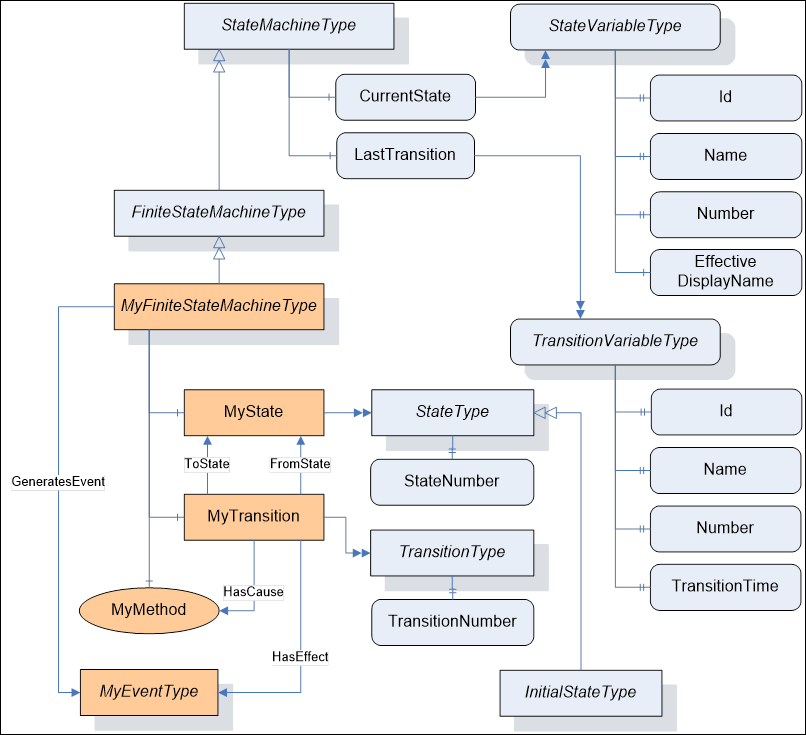
Declaring the state machine
A FiniteStateMachineType is defined by two things, and both are required: the
states it can be in, and the transitions between them. Exactly one state
carries isInitialState: true.
stateMachines:
  - browseName: TemperatureControlStateMachineType
    subtypeOf: ua:FiniteStateMachineType
    description: |
      Controls a temperature sensor: it initialises, measures, and can be halted
      and resumed.
    # Promoting an inherited optional makes it mandatory on every instance, so a
    # client can always read the current state by name.
    promotedToMandatory:
      - ua:CurrentState.ua:Name
      - ua:LastTransition.ua:TransitionTime
    states:
      - name: Initializing
        isInitialState: true
        value: 0
        description: |
          **Initializing** — the sensor is powering up and self-checking.
      - name: Measuring
        value: 1
        description: |
          **Measuring** — the sensor is acquiring temperature values.
      - name: Halted
        value: 2
        description: |
          **Halted** — acquisition has been stopped and can be resumed.
    transitions:
      - from: Initializing
        to: Measuring
        value: 0
      - from: Measuring
        to: Halted
        value: 1
      - from: Halted
        to: Measuring
        value: 2
Each transition names the state it comes from and the state it goes to. The
value is the transition's number in the address space — clients use it to tell
transitions apart.
ua:CurrentState and ua:LastTransition are inherited as optionals. Listing
them under promotedToMandatory makes them mandatory on every instance, so a
client can always read the current state by name without checking whether the
node exists.
Using it on an object type
A state machine becomes useful once an object type owns one. Declare it as a
component whose typeDefinition is the state machine type:
objectTypes:
  - browseName: TemperatureSensorType
    subtypeOf: di:ComponentType
    description: A temperature sensor driven by a state machine.
    components:
      - browseName: ControlState
        typeDefinition: TemperatureControlStateMachineType
        description: The state machine controlling this sensor.

instances:
  - browseName: MyTemperatureSensor
    typeDefinition: TemperatureSensorType
    organizedBy: /ua:Objects
Generating this model produces MyTemperatureSensor with a ControlState
component, its three states, and the three transitions between them.
Going further
- Finite state machines in the DSL reference covers the full syntax, including hierarchical machines.
- Promoting optional members
explains
promotedToMandatoryin more detail.