A homogenizer line in OPC UA FX
This page is a worked example. The normative text is the
OPC UA YAML DSL specification and its
Addendum FX, which defines the fx: vocabulary
(guide).
OPC UA FX exists for one job: letting controllers of different vendors exchange data with each other, without a gateway and without a fieldbus of their own. The OPC Foundation tells it with a machine-integration story, in its technical paper OPC UA FX: Extending OPC UA to the Field: a blending skid built by one vendor is integrated into a homogenizer built by another. This page models that line, end to end, in the DSL.
| Who | What it is | In the model |
|---|---|---|
| Vendor 2 | a blending skid: its PLC and a pH analyzer | BlendingSkidACType, two instances |
| Vendor 1 | the homogenizer and its line controller | HomogenizerACType, one instance |
| The integrator | a dashboard on an edge PC | LineDashboard, declared on the instance |
The machine
The line makes a blended product, a sauce or a dairy drink for instance (the scenario is illustrative). Base product enters a blending skid, which doses an additive into it at a ratio and a flow rate, and checks the result with a pH analyzer. The blend goes on to the homogenizer, which forces it through a narrow gap under high pressure so that it comes out uniform. Two identical skids alternate batches: one prepares while the other delivers, so the homogenizer never waits.
For each batch, the homogenizer drives the skid:
- it says it can take product (
HomogenizerReady) and sends the batch's recipe, ratio and flow as one value (BlendSetpoint); - it starts the skid (
StartBlend); - the skid reports where it is (
SkidState: Idle, Filling, Blending, Held, Faulted) and the flow it actually delivers (ActualFlowRate), and the homogenizer adapts to them; - a dashboard on an edge PC shows the state of both skids.
Every one of those signals crosses from one vendor's controller to another's over OPC UA FX, with no gateway between them. The figure shows the controllers, the signals each one publishes and subscribes to, and the Connection Manager that sets the connections up once and then stays out of the traffic. Each signal runs from an output to the input it feeds, with its DataType; the badges mark the ControlGroups: what only the line controller (LC) or the maintenance technician (M) may use, and what Maintenance blocks for everyone while it holds the skid.
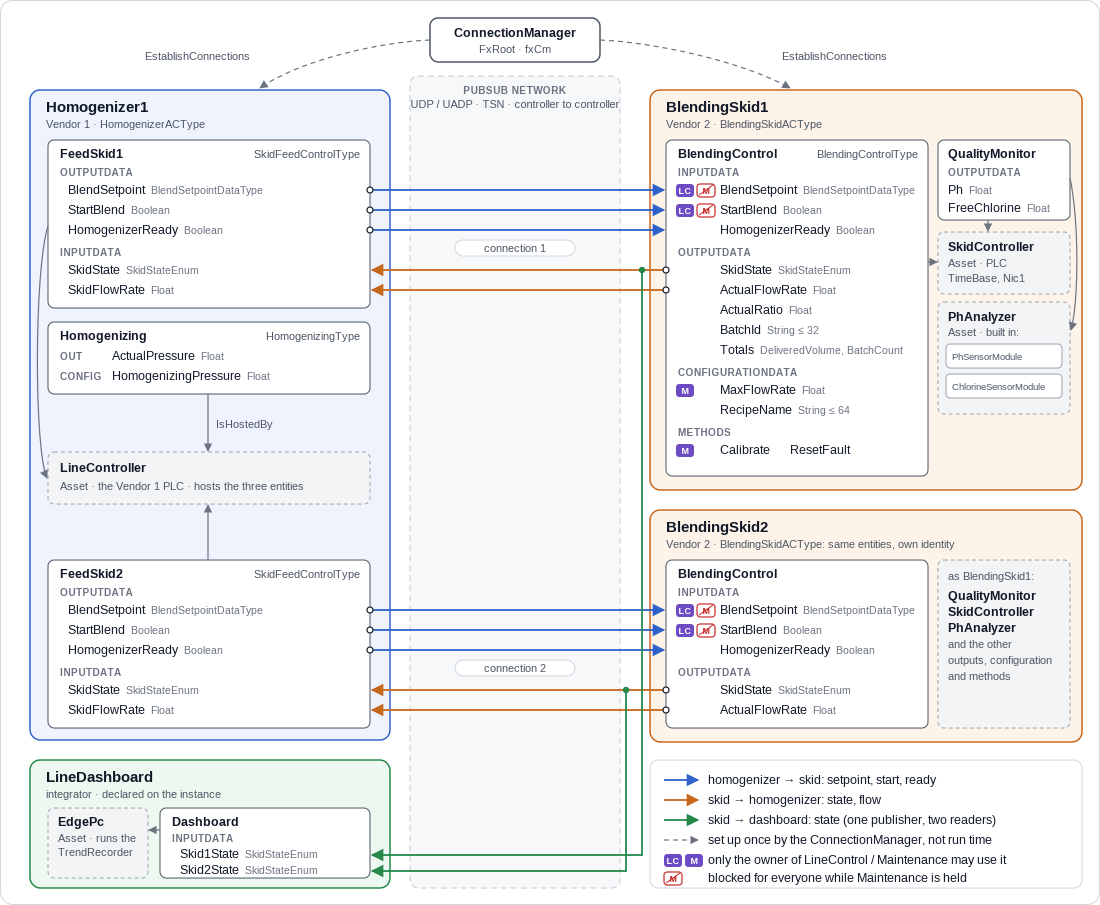
For skid N (1 or 2):
| Signal | Published by | Subscribed by (as) | DataType |
|---|---|---|---|
BlendSetpoint | Homogenizer1, FeedSkidN | BlendingSkidN (BlendSetpoint) | BlendSetpointDataType |
StartBlend | Homogenizer1, FeedSkidN | BlendingSkidN (StartBlend) | Boolean |
HomogenizerReady | Homogenizer1, FeedSkidN | BlendingSkidN (HomogenizerReady) | Boolean |
SkidState | BlendingSkidN | Homogenizer1, FeedSkidN (SkidState); LineDashboard (SkidNState) | SkidStateEnum |
ActualFlowRate | BlendingSkidN | Homogenizer1, FeedSkidN (SkidFlowRate) | Float |
Each skid has its own connection, to its own feed entity on the homogenizer. Two skids
publishing into one SkidState input would overwrite each other, so the homogenizer has one
FeedSkid entity per skid: two instances of one type, as the skids are. SkidState is
published once and read by two subscribers. The quality monitor publishes Ph and FreeChlorine too; nothing on this line
subscribes to them yet, which is how a quality system could be added later without touching
the skids.
The model follows the path the OPC Foundation's Learn@Lunch talk on simplified machine integration lays out for an FX controller: an OPC UA server, then the information models (the assets, and the data each function exchanges), then the Connection Manager that sets the connections up, and the descriptors for offline engineering. The PubSub transport and its security keys are run-time matters, and stay out of the model (What the model does not hold).
All the examples share one header: the namespaces, and the two DataTypes the skid and the homogenizer exchange. A structure is exchanged as one value, so a batch setpoint arrives whole.
namespaceUri: http://sterfive.com/UA/FX/HomogenizerLine/
version: 1.0.0
publicationDate: "2026-11-26T00:00:00Z"
namespaces:
  - di
  - fxData
  - fxAc
  - fxCm
dataTypes:
  - browseName: SkidStateEnum
    description: The state of a blending skid, as the homogenizer sees it.
    enum:
      - { name: Idle, value: 0 }
      - { name: Filling, value: 1 }
      - { name: Blending, value: 2 }
      - { name: Held, value: 3 }
      - { name: Faulted, value: 4 }
  - browseName: BlendSetpointDataType
    description: What the homogenizer asks of a skid for one batch, exchanged as one structure.
    fields:
      - { name: Ratio, dataType: ua:Float, description: Additive to base ratio, 0 to 1. }
      - { name: FlowRate, dataType: ua:Float, description: Requested flow rate, in l/min. }
      - { name: RecipeId, dataType: ua:UInt32 }
The hardware: Assets
An Asset is a piece of hardware (or firmware, or a licence) an AutomationComponent is made of.
The skid carries a pH analyzer, the asset example of the OPC Foundation paper: one device with
two measuring modules built in. nameplate makes the di identification Properties Mandatory,
builtIn declares the modules (HasBuiltInAsset), and connectors lists the device's sockets.
- With fx:
- Plain DSL
objectTypes:
  - browseName: PhSensorModuleType
    description: The pH measuring module built into the analyzer.
    components:
      - { browseName: ElectrodeAge, dataType: ua:Duration }
  - browseName: ChlorineSensorModuleType
    description: The free-chlorine measuring module built into the analyzer.
    components:
      - { browseName: MembraneAge, dataType: ua:Duration }
  - browseName: PhAnalyzerType
    description: A pH analyzer with a pH and a chlorine sensor module built in.
    fx:
      asset:
        nameplate: [Manufacturer, Model, SerialNumber, HardwareRevision]
        builtIn:
          - { browseName: PhSensorModule, typeDefinition: PhSensorModuleType }
          - { browseName: ChlorineSensorModule, typeDefinition: ChlorineSensorModuleType }
        connectors:
          - { browseName: Ethernet, typeDefinition: fxAc:SocketType }
          - { browseName: SensorPort1, typeDefinition: fxAc:SocketType }
          - { browseName: SensorPort2, typeDefinition: fxAc:SocketType }
objectTypes:
  - browseName: PhSensorModuleType
    description: The pH measuring module built into the analyzer.
    components:
      - { browseName: ElectrodeAge, dataType: ua:Duration }
  - browseName: ChlorineSensorModuleType
    description: The free-chlorine measuring module built into the analyzer.
    components:
      - { browseName: MembraneAge, dataType: ua:Duration }
  - browseName: PhAnalyzerType
    subtypeOf: fxAc:FxAssetType
    description: A pH analyzer with a pH and a chlorine sensor module built in.
    promotedToMandatory:
      - di:Manufacturer
      - di:Model
      - di:SerialNumber
      - di:HardwareRevision
    components:
      - browseName: fxAc:Connectors
        components:
          - { browseName: Ethernet, typeDefinition: fxAc:SocketType }
          - { browseName: SensorPort1, typeDefinition: fxAc:SocketType }
          - { browseName: SensorPort2, typeDefinition: fxAc:SocketType }
    references:
      - referenceType: fxAc:HasBuiltInAsset
        source: /
        target: { browseName: PhSensorModule, typeDefinition: PhSensorModuleType }
      - referenceType: fxAc:HasBuiltInAsset
        source: /
        target: { browseName: ChlorineSensorModule, typeDefinition: ChlorineSensorModuleType }
The skid's PLC is an embedded controller. Beside its nameplate, it exposes what a field device
with deterministic communication depends on: the clock PubSub schedules against, and its
Ethernet port. An fx: block is a shorthand, not a cage: plain keys such as components: sit
beside it.
objectTypes:
  - browseName: TimeBaseType
    description: The internal clock PubSub and TSN schedule against.
    components:
      - { browseName: SyncSource, dataType: ua:String }
      - { browseName: OffsetFromGrandmaster, dataType: ua:Duration }
  - browseName: NetworkInterfaceDeviceType
    description: An Ethernet port of the controller, TSN capable.
    components:
      - { browseName: MacAddress, dataType: ua:String }
      - { browseName: LinkSpeed, dataType: ua:UInt32 }
      - { browseName: TsnCapable, dataType: ua:Boolean }
  - browseName: SkidControllerType
    description: The Vendor 2 PLC of the blending skid, an embedded controller.
    components:
      - { browseName: TimeBase, typeDefinition: TimeBaseType }
      - { browseName: Nic1, typeDefinition: NetworkInterfaceDeviceType }
    fx:
      asset:
        nameplate: [Manufacturer, Model, SerialNumber, SoftwareRevision]
        connectors:
          - { browseName: Port1, typeDefinition: fxAc:SocketType }
          - { browseName: Port2, typeDefinition: fxAc:SocketType }
The skid's function: a FunctionalEntity
A FunctionalEntity is what a device offers to the exchange. The skid offers its blending
function: it takes a setpoint and a start command in InputData, publishes its state and what it
actually delivers in OutputData, and keeps its limits in ConfigurationData. The author
triple is what a Connection Manager compares with the engineering before it connects.
- A String exchanged by PubSub has a fixed place in the message, so it carries
MaxStringLength(DSL-W-FX-006 reminds you). Totalshascomponents:and nodataType: it is a group, a nested folder of outputs.publisherCapabilitiessays the skid publishes only preconfigured DataSets.
Two ControlGroups say who may command the skid. The line controller owns LineControl: the
setpoint and the start are its alone. A maintenance technician who takes Maintenance gets the
flow limit and calibration, and while they hold it nobody can start a batch or change the
setpoint (block). related lists what each owner watches.
objectTypes:
  - browseName: BlendingControlType
    description: >-
      The blending function of the skid, as offered to the line: it takes a setpoint and a start
      command, and publishes its state and its actual flow and ratio.
    methods:
      - browseName: ResetFault
        description: Leaves Faulted for Idle.
      - browseName: Calibrate
        description: Calibrates the flow meters; maintenance only.
    fx:
      functionalEntity:
        author: { uri: http://vendor2.example.com, identifier: BlendCtl, version: 2.1.0.0 }
        inputs:
          - browseName: BlendSetpoint
            dataType: BlendSetpointDataType
            accessLevel: CurrentRead | CurrentWrite
          - browseName: StartBlend
            dataType: ua:Boolean
            accessLevel: CurrentRead | CurrentWrite
          - browseName: HomogenizerReady
            dataType: ua:Boolean
            accessLevel: CurrentRead | CurrentWrite
        outputs:
          - browseName: SkidState
            dataType: SkidStateEnum
          - browseName: ActualFlowRate
            dataType: ua:Float
          - browseName: ActualRatio
            dataType: ua:Float
          - browseName: BatchId
            dataType: ua:String
            properties:
              - { browseName: ua:MaxStringLength, dataType: ua:UInt32, value: 32 }
          - browseName: Totals
            components:
              - { browseName: DeliveredVolume, dataType: ua:Double }
              - { browseName: BatchCount, dataType: ua:UInt32 }
        configuration:
          - browseName: MaxFlowRate
            dataType: ua:Float
            accessLevel: CurrentRead | CurrentWrite
          - browseName: RecipeName
            dataType: ua:String
            accessLevel: CurrentRead | CurrentWrite
            properties:
              - { browseName: ua:MaxStringLength, dataType: ua:UInt32, value: 64 }
        publisherCapabilities: [PreconfiguredDataSetOnly]
        controlGroups:
          - browseName: LineControl
            restrict: [BlendSetpoint, StartBlend]
            related: [SkidState, ActualFlowRate, ActualRatio]
          - browseName: Maintenance
            restrict: [MaxFlowRate, Calibrate]
            block: [StartBlend, BlendSetpoint]
            related: [SkidState]
The homogenizer's side: one feed per skid
The homogenizer's side of a skid connection is the mirror of the skid's entity: what one
publishes, the other subscribes to. Reading the two types side by side is reading the connection,
before any network exists: the signal table of The machine comes straight from
their InputData and OutputData. The homogenizer's own work, the pressure it homogenizes at,
is a function of its own, Homogenizing: it has nothing to do with any one skid.
objectTypes:
  - browseName: SkidFeedControlType
    description: >-
      The homogenizer's side of one skid connection, the mirror of BlendingControl: it publishes
      the setpoint and subscribes to the skid's state. The homogenizer has one per skid.
    fx:
      functionalEntity:
        author: { uri: http://vendor1.example.com, identifier: SkidFeed, version: 4.0.0.12 }
        inputs:
          - browseName: SkidState
            dataType: SkidStateEnum
            accessLevel: CurrentRead | CurrentWrite
          - browseName: SkidFlowRate
            dataType: ua:Float
            accessLevel: CurrentRead | CurrentWrite
        outputs:
          - { browseName: BlendSetpoint, dataType: BlendSetpointDataType }
          - { browseName: StartBlend, dataType: ua:Boolean }
          - { browseName: HomogenizerReady, dataType: ua:Boolean }
  - browseName: HomogenizingType
    description: The homogenizer's own function, the pressure it homogenizes at.
    fx:
      functionalEntity:
        author: { uri: http://vendor1.example.com, identifier: Homogenizing, version: 4.0.0.12 }
        outputs:
          - { browseName: ActualPressure, dataType: ua:Float }
        configuration:
          - browseName: HomogenizingPressure
            dataType: ua:Float
            accessLevel: CurrentRead | CurrentWrite
The whole line
The last step puts the pieces together, and this block is the complete model.
- The AutomationComponents.
BlendingSkidACTypegathers the skid's two Assets and two FunctionalEntities, andhostedBynames the Assets each entity needs to run. The quality monitor needs two, the analyzer that measures and the PLC that runs it, so it takes a list.HomogenizerACTypedoes the same for the other vendor: its ownHomogenizingfunction, and one feed entity per skid.fxAc:ConnectionEndpointsis declared on each exchanging entity: it is where the Connection Manager creates the connection endpoints. - Two skids, one type.
BlendingSkid1andBlendingSkid2are two instances underFxRoot. Each will be a different network identity with its own connection; the model gives them the same structure. - Certification and offline engineering. Only a product that passed the OPC Foundation's
UAFX testing may carry the UAFX name, and
ConformanceNamepoints at its certificate. A descriptor names the vendor's Product Descriptor (an AutomationML package) an engineering tool works from before the skid is on site; the skid'sfx:block lists it underdescriptors:, and it carries the identifier and version a Descriptor needs (or a file: DSL-E-FX-009). - An AutomationComponent declared on its instance. The dashboard has no type of its own: its
fx:block declares its Asset and FunctionalEntity in place, and puts it underFxRoot. Its trend recorder is a sub-function that states where it executes withfx: executingOn. - The figure of the line.
documentation.descriptionplaces the System topology figure in the generated documentation with!figure(topology): the controllers, their Assets and FunctionalEntities, and the signals of the connections below, read back from the compiled ConnectionConfigurationSet (the vocabulary page has the arguments). - Who feeds whom.
LineConnectionsis the Connection Manager's configuration of the signal table, aconnectionConfigurationSet: one connection per skid from the homogenizer, one per skid to the dashboard. Each endpoint names the FunctionalEntity it connects and lists the variables it sends (outputs) and receives into (inputs); one endpoint's outputs feed the other's inputs in order, soActualFlowRatefeedsSkidFlowRate, an input of another name. The set compiles into the NodeSet, as OPC 10000-81 configures it (FunctionalEntityNode,OutputVariableIds,InputVariableIds, as browse paths); the generated documentation draws it and the modeler checks each name and DataType.
connectionConfigurationSet needs a modeler newer than CLI 2.31.0. With 2.31.0, leave the
LineConnections instance out: the rest of the model compiles as it is.
documentation:
  title: The homogenizer line
  description: |
    Two blending skids of Vendor 2 feed a homogenizer of Vendor 1; a dashboard watches both.

    !figure(topology)
objectTypes:
  # ---------------------------------------------------------------- Assets
  - browseName: PhSensorModuleType
    description: The pH measuring module built into the analyzer.
    components:
      - { browseName: ElectrodeAge, dataType: ua:Duration }
  - browseName: ChlorineSensorModuleType
    description: The free-chlorine measuring module built into the analyzer.
    components:
      - { browseName: MembraneAge, dataType: ua:Duration }
  - browseName: PhAnalyzerType
    description: A pH analyzer with a pH and a chlorine sensor module built in.
    fx:
      asset:
        nameplate: [Manufacturer, Model, SerialNumber, HardwareRevision]
        builtIn:
          - { browseName: PhSensorModule, typeDefinition: PhSensorModuleType }
          - { browseName: ChlorineSensorModule, typeDefinition: ChlorineSensorModuleType }
        connectors:
          - { browseName: Ethernet, typeDefinition: fxAc:SocketType }
          - { browseName: SensorPort1, typeDefinition: fxAc:SocketType }
          - { browseName: SensorPort2, typeDefinition: fxAc:SocketType }

  - browseName: TimeBaseType
    description: The internal clock PubSub and TSN schedule against.
    components:
      - { browseName: SyncSource, dataType: ua:String }
      - { browseName: OffsetFromGrandmaster, dataType: ua:Duration }
  - browseName: NetworkInterfaceDeviceType
    description: An Ethernet port of the controller, TSN capable.
    components:
      - { browseName: MacAddress, dataType: ua:String }
      - { browseName: LinkSpeed, dataType: ua:UInt32 }
      - { browseName: TsnCapable, dataType: ua:Boolean }
  - browseName: SkidControllerType
    description: The Vendor 2 PLC of the blending skid, an embedded controller.
    components:
      - { browseName: TimeBase, typeDefinition: TimeBaseType }
      - { browseName: Nic1, typeDefinition: NetworkInterfaceDeviceType }
    fx:
      asset:
        nameplate: [Manufacturer, Model, SerialNumber, SoftwareRevision]
        connectors:
          - { browseName: Port1, typeDefinition: fxAc:SocketType }
          - { browseName: Port2, typeDefinition: fxAc:SocketType }

  - browseName: LineControllerType
    description: The Vendor 1 PLC of the homogenizer.
    fx:
      asset:
        nameplate: [Manufacturer, Model, SerialNumber]

  # ---------------------------------------------------------------- FunctionalEntities
  - browseName: BlendingControlType
    description: >-
      The blending function of the skid, as offered to the line: it takes a setpoint and a start
      command, and publishes its state and its actual flow and ratio.
    methods:
      - browseName: ResetFault
        description: Leaves Faulted for Idle.
      - browseName: Calibrate
        description: Calibrates the flow meters; maintenance only.
    fx:
      functionalEntity:
        author: { uri: http://vendor2.example.com, identifier: BlendCtl, version: 2.1.0.0 }
        inputs:
          - browseName: BlendSetpoint
            dataType: BlendSetpointDataType
            accessLevel: CurrentRead | CurrentWrite
          - browseName: StartBlend
            dataType: ua:Boolean
            accessLevel: CurrentRead | CurrentWrite
          - browseName: HomogenizerReady
            dataType: ua:Boolean
            accessLevel: CurrentRead | CurrentWrite
        outputs:
          - browseName: SkidState
            dataType: SkidStateEnum
          - browseName: ActualFlowRate
            dataType: ua:Float
          - browseName: ActualRatio
            dataType: ua:Float
          - browseName: BatchId
            dataType: ua:String
            properties:
              - { browseName: ua:MaxStringLength, dataType: ua:UInt32, value: 32 }
          - browseName: Totals
            components:
              - { browseName: DeliveredVolume, dataType: ua:Double }
              - { browseName: BatchCount, dataType: ua:UInt32 }
        configuration:
          - browseName: MaxFlowRate
            dataType: ua:Float
            accessLevel: CurrentRead | CurrentWrite
          - browseName: RecipeName
            dataType: ua:String
            accessLevel: CurrentRead | CurrentWrite
            properties:
              - { browseName: ua:MaxStringLength, dataType: ua:UInt32, value: 64 }
        publisherCapabilities: [PreconfiguredDataSetOnly]
        controlGroups:
          - browseName: LineControl
            restrict: [BlendSetpoint, StartBlend]
            related: [SkidState, ActualFlowRate, ActualRatio]
          - browseName: Maintenance
            restrict: [MaxFlowRate, Calibrate]
            block: [StartBlend, BlendSetpoint]
            related: [SkidState]

  - browseName: QualityMonitorType
    description: Publishes the product quality the analyzer measures.
    fx:
      functionalEntity:
        author: { uri: http://vendor2.example.com, identifier: QualMon, version: 1.0.3.0 }
        outputs:
          - { browseName: Ph, dataType: ua:Float }
          - { browseName: FreeChlorine, dataType: ua:Float }
        configuration:
          - browseName: PhHighLimit
            dataType: ua:Float
            accessLevel: CurrentRead | CurrentWrite

  - browseName: SkidFeedControlType
    description: >-
      The homogenizer's side of one skid connection, the mirror of BlendingControl: it publishes
      the setpoint and subscribes to the skid's state. The homogenizer has one per skid.
    fx:
      functionalEntity:
        author: { uri: http://vendor1.example.com, identifier: SkidFeed, version: 4.0.0.12 }
        inputs:
          - browseName: SkidState
            dataType: SkidStateEnum
            accessLevel: CurrentRead | CurrentWrite
          - browseName: SkidFlowRate
            dataType: ua:Float
            accessLevel: CurrentRead | CurrentWrite
        outputs:
          - { browseName: BlendSetpoint, dataType: BlendSetpointDataType }
          - { browseName: StartBlend, dataType: ua:Boolean }
          - { browseName: HomogenizerReady, dataType: ua:Boolean }
  - browseName: HomogenizingType
    description: The homogenizer's own function, the pressure it homogenizes at.
    fx:
      functionalEntity:
        author: { uri: http://vendor1.example.com, identifier: Homogenizing, version: 4.0.0.12 }
        outputs:
          - { browseName: ActualPressure, dataType: ua:Float }
        configuration:
          - browseName: HomogenizingPressure
            dataType: ua:Float
            accessLevel: CurrentRead | CurrentWrite

  - browseName: DashboardType
    description: The line dashboard; subscribes to the state of every skid.
    fx:
      functionalEntity:
        inputs:
          - browseName: Skid1State
            dataType: SkidStateEnum
            accessLevel: CurrentRead | CurrentWrite
          - browseName: Skid2State
            dataType: SkidStateEnum
            accessLevel: CurrentRead | CurrentWrite
        subscriberCapabilities: [PreconfiguredDataSetOnly]

  # ---------------------------------------------------------------- AutomationComponents
  - browseName: BlendingSkidACType
    description: The Vendor 2 blending skid as one AutomationComponent.
    fx:
      automationComponent:
        assets:
          - { browseName: SkidController, typeDefinition: SkidControllerType }
          - { browseName: PhAnalyzer, typeDefinition: PhAnalyzerType }
        functionalEntities:
          - browseName: BlendingControl
            typeDefinition: BlendingControlType
            hostedBy: SkidController
            optionals: [fxAc:ConnectionEndpoints]
          - browseName: QualityMonitor
            typeDefinition: QualityMonitorType
            hostedBy: [PhAnalyzer, SkidController]
            optionals: [fxAc:ConnectionEndpoints]

  - browseName: HomogenizerACType
    description: >-
      The Vendor 1 homogenizer as one AutomationComponent: its own function, and one feed entity
      per skid it takes product from.
    fx:
      automationComponent:
        assets:
          - { browseName: LineController, typeDefinition: LineControllerType }
        functionalEntities:
          - browseName: Homogenizing
            typeDefinition: HomogenizingType
            hostedBy: LineController
          - browseName: FeedSkid1
            typeDefinition: SkidFeedControlType
            hostedBy: LineController
            optionals: [fxAc:ConnectionEndpoints]
          - browseName: FeedSkid2
            typeDefinition: SkidFeedControlType
            hostedBy: LineController
            optionals: [fxAc:ConnectionEndpoints]

instances:
  # two identical skids on one line: one type, two network identities
  - browseName: BlendingSkid1
    typeDefinition: BlendingSkidACType
    organizedBy: /ua:Objects/fxData:FxRoot
    propertyValues:
      fxAc:ConformanceName: http://opcfoundation.org/products/view/Vendor2-BlendingSkid-UAFX
    fx:
      automationComponent:
        descriptors:
          - browseName: ProductDescriptor
            description: The vendor's Product Descriptor (AutomationML package) of the skid.
            optionals: [fxAc:DescriptorIdentifier, fxAc:DescriptorVersion]
  - browseName: BlendingSkid2
    typeDefinition: BlendingSkidACType
    organizedBy: /ua:Objects/fxData:FxRoot
  - browseName: Homogenizer1
    typeDefinition: HomogenizerACType
    organizedBy: /ua:Objects/fxData:FxRoot

  # an AutomationComponent declared on the instance: FxRoot placement is implied
  - browseName: LineDashboard
    fx:
      automationComponent:
        assets:
          - browseName: EdgePc
            typeDefinition: fxAc:FxAssetType
            optionals: [di:Manufacturer, di:Model]
        functionalEntities:
          - browseName: Dashboard
            typeDefinition: DashboardType
            hostedBy: EdgePc
  - browseName: TrendRecorder
    typeDefinition: fxAc:FunctionalEntityType
    description: A sub-function of the dashboard, running on the edge PC.
    componentOf: $Dashboard
    fx:
      executingOn: $EdgePc

  # who feeds whom: the Connection Manager's configuration. An endpoint's outputs feed the other
  # endpoint's inputs, in order.
  - browseName: LineConnections
    fx:
      connectionConfigurationSet:
        communicationFlows:
          - browseName: HomogenizerFlow
            subscribers: [{ browseName: Skid1 }, { browseName: Skid2 }]
          - browseName: Skid1Flow
            subscribers: [{ browseName: Homogenizer }, { browseName: Dashboard }]
          - browseName: Skid2Flow
            subscribers: [{ browseName: Homogenizer }, { browseName: Dashboard }]
        connections:
          - browseName: Skid1Line
            endpoint1:
              functionalEntity: Homogenizer1/FeedSkid1
              outboundFlow: HomogenizerFlow
              inboundFlow: Skid1Flow/Homogenizer
              outputs: [BlendSetpoint, StartBlend, HomogenizerReady]
              inputs: [SkidState, SkidFlowRate]
            endpoint2:
              functionalEntity: BlendingSkid1/BlendingControl
              outboundFlow: Skid1Flow
              inboundFlow: HomogenizerFlow/Skid1
              outputs: [SkidState, ActualFlowRate]
              inputs: [BlendSetpoint, StartBlend, HomogenizerReady]
          - browseName: Skid2Line
            endpoint1:
              functionalEntity: Homogenizer1/FeedSkid2
              outboundFlow: HomogenizerFlow
              inboundFlow: Skid2Flow/Homogenizer
              outputs: [BlendSetpoint, StartBlend, HomogenizerReady]
              inputs: [SkidState, SkidFlowRate]
            endpoint2:
              functionalEntity: BlendingSkid2/BlendingControl
              outboundFlow: Skid2Flow
              inboundFlow: HomogenizerFlow/Skid2
              outputs: [SkidState, ActualFlowRate]
              inputs: [BlendSetpoint, StartBlend, HomogenizerReady]
          - browseName: Skid1Monitor
            endpoint1:
              functionalEntity: LineDashboard/Dashboard
              inboundFlow: Skid1Flow/Dashboard
              inputs: [Skid1State]
            endpoint2:
              functionalEntity: BlendingSkid1/BlendingControl
              outboundFlow: Skid1Flow
              outputs: [SkidState]
          - browseName: Skid2Monitor
            endpoint1:
              functionalEntity: LineDashboard/Dashboard
              inboundFlow: Skid2Flow/Dashboard
              inputs: [Skid2State]
            endpoint2:
              functionalEntity: BlendingSkid2/BlendingControl
              outboundFlow: Skid2Flow
              outputs: [SkidState]
        automationComponents:
          - browseName: Homogenizer1
            endpoints: [Skid1Line/Endpoint1, Skid2Line/Endpoint1]
          - browseName: BlendingSkid1
            endpoints: [Skid1Line/Endpoint2, Skid1Monitor/Endpoint2]
          - browseName: BlendingSkid2
            endpoints: [Skid2Line/Endpoint2, Skid2Monitor/Endpoint2]
          - browseName: LineDashboard
            endpoints: [Skid1Monitor/Endpoint1, Skid2Monitor/Endpoint1]
        serverAddresses:
          - { browseName: Homogenizer1Address, automationComponent: Homogenizer1 }
          - { browseName: BlendingSkid1Address, automationComponent: BlendingSkid1 }
          - { browseName: BlendingSkid2Address, automationComponent: BlendingSkid2 }
          - { browseName: LineDashboardAddress, automationComponent: LineDashboard }
The model compiles with no diagnostic: the FX conformance rules find every Asset an entity is
hosted by in its Assets folder, every String with its maximum length, and every
AutomationComponent under FxRoot; and every configured connection joins existing outputs to as
many existing inputs, one by one and of the same DataType, no input fed twice or left unfed.
What the model does not hold
The information model describes what each controller is and what it can exchange. Everything that makes an exchange happen is created at run time, and has no place in it:
- The Connection Manager.
fxCmalready provides it, asFxRoot/ConnectionManager: a server has at most one, and a model that declares a second one gets DSL-W-FX-008. The model ships its configuration,LineConnections; the Connection Manager callsEstablishConnectionson each AutomationComponent with it, and steps aside: the skids and the homogenizer talk directly. - The PubSub objects. The DataSetWriters, DataSetReaders and PublishedDataSets of each
connection, over UDP/UADP or TSN, are created by
EstablishConnections, not declared. - The security keys. The keys that sign and encrypt the PubSub messages are distributed by a Security Key Server, pushed to the controllers or pulled by them.
- The descriptors' content. The Product Descriptor of the vendor and the Configuration Descriptor of the integrator are AutomationML packages, signed; the model holds the node that names them, not the packages.
Going further
- The OPC UA FX vocabulary: every key of the
fx:block, and its plain-DSL expansion. - An OPC UA FX drive: one AutomationComponent, step by step.
- Samples from OPC 10000-81 Annex D, rebuilt in the DSL.
- The specifications: OPC 10000-80, OPC 10000-81 and OPC 10000-82.